Wisconsin Planting Zones Explained: Checking Your USDA Hardiness
Wisconsin gardeners often see a USDA hardiness zone on a plant tag and wonder whether it tells them when to plant. It answers a narrower question: how well a perennial plant may tolerate winter cold. Here’s how to check the zone for your area, understand what it can and can’t predict, and use it alongside local weather and site conditions.
What a USDA hardiness zone tells you
The USDA Plant Hardiness Zone Map groups locations by their average annual extreme minimum winter temperature. In other words, it describes the low temperature a place typically reaches in its coldest part of the year—not its average winter temperature, average snowfall, or the length of its growing season.
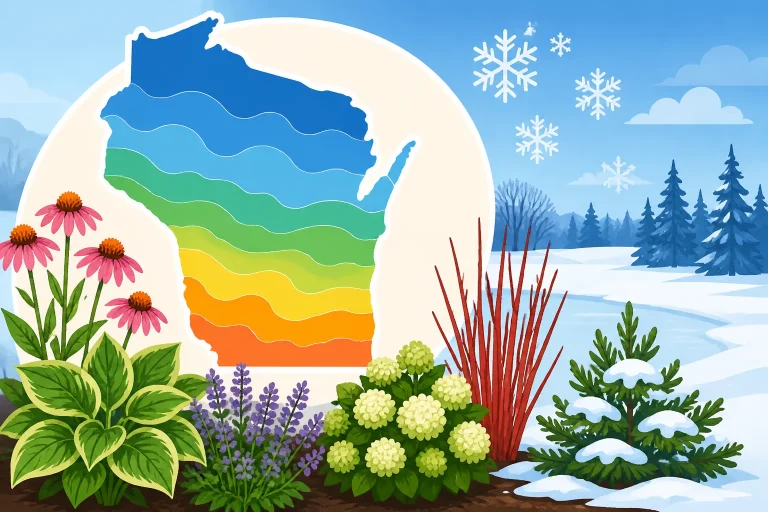
The map uses temperature bands, divided into full zones and half-zone subdivisions. A half zone represents a narrower range within a full zone. A lower-numbered zone indicates a colder winter minimum than a higher-numbered zone. The difference matters when choosing a perennial, shrub, or tree whose winter survival depends on how much cold it can withstand.
A plant labeled hardy to a particular zone is generally expected to tolerate the winter minimum associated with that zone under suitable growing conditions. That label is a useful starting point, not a guarantee. A plant can be damaged by unusual cold, winter winds, poor drainage, late-season growth, or a sudden temperature drop, even if the yard falls within its listed zone. A well-sited plant may sometimes do better than its label suggests, but that is not a dependable basis for choosing a tender specimen.
The zone is most useful for comparing a plant’s cold tolerance with the winter conditions where it will grow. It does not tell you:
- When spring planting is safe.
- Whether a crop has enough frost-free time to produce a harvest.
- How much snow cover, wind, or winter sun the planting site receives.
- Whether the soil drains well or stays wet through winter.
- How much heat a plant needs in summer.
- Whether a plant will thrive in a particular yard.
That last distinction is especially important for Wisconsin vegetable gardeners. A tomato may be able to grow in a location’s summer conditions, but the hardiness zone alone does not tell you when to set it outside or whether the season will be long enough for a particular variety. Use a planting calendar, local frost information, soil conditions, and the plant’s maturity needs for those decisions. Wisconsin Vegetable Planting Guide: What to Plant by Region offers a crop-focused place to continue.
How to check your USDA hardiness zone in Wisconsin
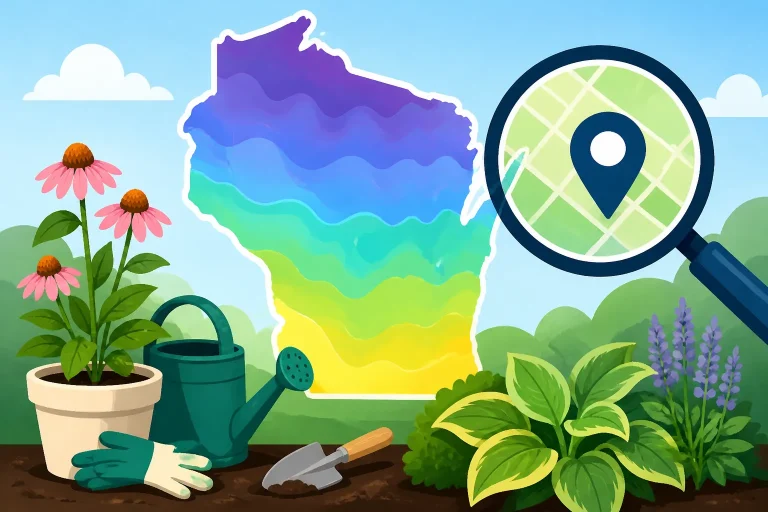
Use the USDA Plant Hardiness Zone Map to look up the area where you plan to garden. You can begin with a ZIP code, then zoom in on the map to see how the zone pattern falls around your location. A ZIP code is a useful search tool, but it covers an area rather than pinpointing the conditions in one yard.
- Open the USDA Plant Hardiness Zone Map.
- Search for the ZIP code associated with your garden or zoom toward the area manually.
- Find the colored area covering the general location, and read the full zone and half-zone shown for that spot.
- Zoom in further and check nearby areas. A boundary may pass close to a neighborhood or cross a larger ZIP code.
- Record the zone as a regional reference, then consider your yard’s exposure, slope, buildings, soil, and drainage before selecting plants.
If a map search gives a result that seems inconsistent with nearby areas, avoid treating the first result as a precise yard-level reading. Check the map itself at a closer scale and compare the surrounding pattern. How to Look Up Your Wisconsin Hardiness Zone by ZIP Code explains the lookup process in more detail, while Wisconsin ZIP Codes and USDA Zones: Mapping 4a Through 6a discusses the state’s broad zone pattern.
A map may show a boundary close to your home, but that does not mean every property on one side of a road shares identical growing conditions. The zone is based on a broad temperature pattern, not a thermometer installed in each yard. A few blocks, a slope, or a sheltered courtyard can affect conditions enough to matter for a sensitive plant.
When recording a zone for a garden, note it as an approximate area-level result rather than an exact property measurement. If you’re choosing a valuable tree or shrub near a map boundary, it can be sensible to choose one rated for the colder of the nearby zones. That adds a margin for winter stress, though it does not replace checking the plant’s soil, light, and moisture needs.
Why Wisconsin’s zone pattern varies
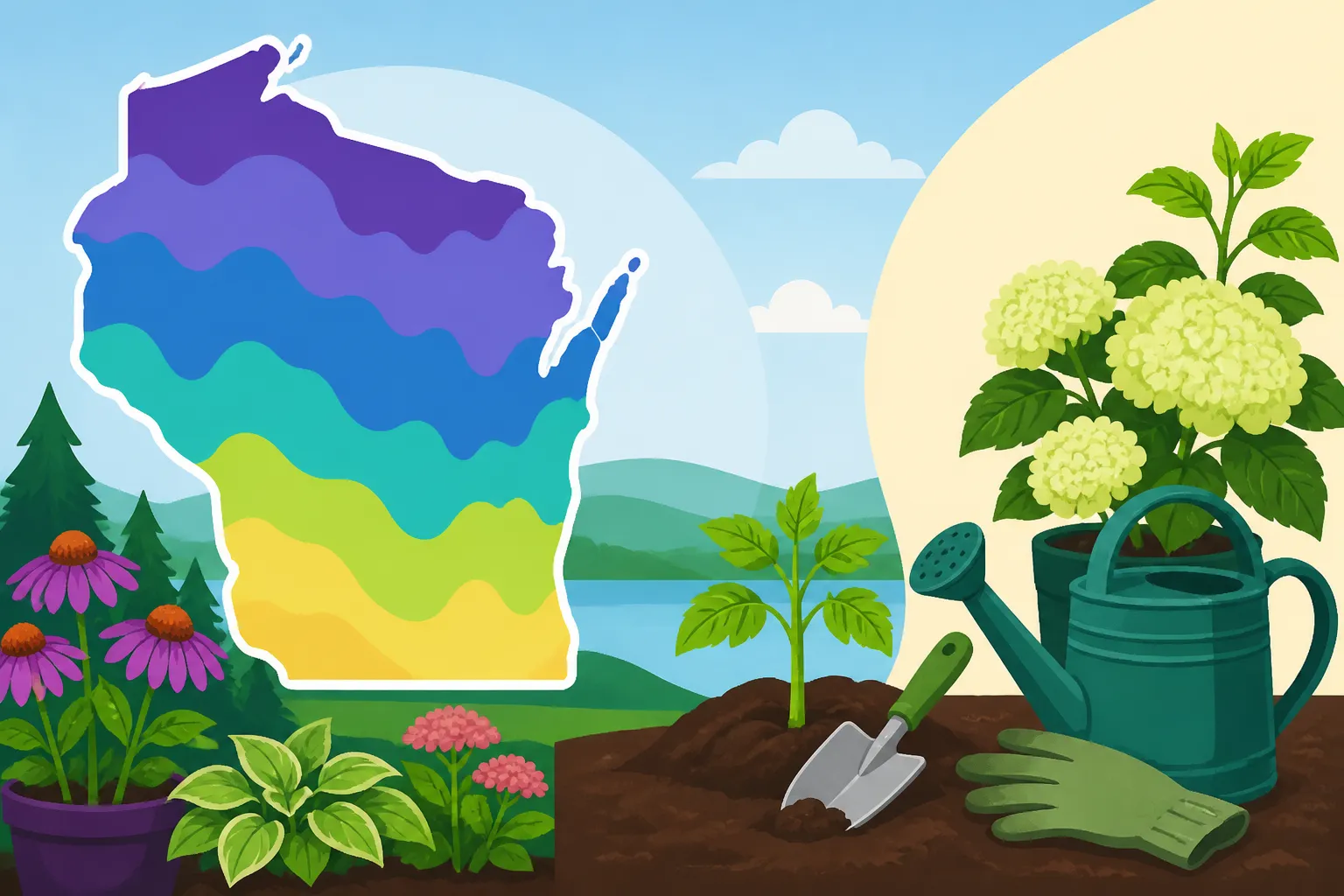
Wisconsin does not have one hardiness zone that applies to every community. Winter minimum temperatures vary across the state, and the map reflects that regional variation. Broad differences in geography, distance from large bodies of water, and local terrain all help explain why nearby areas may not share the same mapped zone.
The map’s colors can make these differences look crisp, but winter conditions do not change abruptly at a line drawn on a map. The boundary represents a transition in mapped temperature averages, not a fence separating two entirely different climates. In real yards, conditions can shift gradually, and a small area may behave differently from the surrounding landscape.
For a gardener, this means a zone printed for one Wisconsin ZIP code should not automatically be applied to another, even if the places seem close. It also means that a plant’s success at a neighbor’s home is useful information but not proof it will succeed in your own yard. Their site may be more sheltered, better drained, or protected by reliable snow cover.
When comparing zone results, keep the purpose narrow: the map helps you estimate the typical winter cold that plants may face. It does not rank neighborhoods by overall gardening potential. Two areas in the same zone could have different spring timing, summer heat, wind exposure, soil moisture, or growing-season length.
For help understanding what a zone means for winter plant selection, see Wisconsin Hardiness Zones: Matching Plants to Your Winter Minimums. If your location is close to a boundary, Choosing Hardy Cultivars: Erring on the Colder Subzone in Wisconsin explains why choosing for the colder nearby result can be a cautious approach.
What hardiness zones do not tell you
They do not give safe spring planting dates
A hardiness zone is based on winter minimum temperatures. It does not predict the date of the last spring frost or tell you whether a warm spell will last. A perennial might survive a Wisconsin winter yet still be injured if new growth emerges during a spring cold snap.
Vegetables add another layer of timing. Cool-season crops may tolerate chilly weather, while warm-season crops generally need warmer conditions. The right planting window also depends on soil temperature, forecast conditions, and the crop’s tolerance of frost. A zone is not a substitute for those checks.
Use local frost probabilities and current forecasts to assess spring risk. Frost dates are estimates with a probability, not promises that frost will or will not occur on a particular day. For more on that distinction, read Understanding Wisconsin Last Frost Dates: Probability vs Safe Timing and Looking Beyond Frost Dates: Checking Weather and Soil.
They do not measure growing-season length
A zone does not say how many frost-free days your yard will have, or how much time a vegetable variety needs to mature. A short-season cultivar may be a better fit for a northern or otherwise cool site than a variety that requires a longer stretch of warm weather, even when both can technically tolerate the winter minimum.
That is one reason planting calendars and seed packets remain useful after you check your zone. A calendar helps you plan when to sow or transplant; the zone helps you screen perennial plants for winter cold. For practical timing across the state, see Wisconsin Vegetable Planting Calendar: Spring and Fall Schedules and How Vegetable Planting Dates Shift From South to North Wisconsin.
They do not account for your yard’s microclimate
A yard can be warmer or colder than the surrounding area. Buildings and walls may shelter a planting from wind or hold warmth, while low spots can collect cold air. A sunny south-facing wall may support a more sheltered planting than an exposed site, but reflected heat and drying winds can create different stresses of their own.
These local differences matter most for plants near their cold-tolerance limit, as well as for spring growth, flowering, and frost exposure. Dane County Garden Microclimates: How Buildings and Slopes Shift Frost describes how yard features can influence conditions, and Spotting Frost Pockets in Wisconsin Valleys and Low Spots focuses on colder areas where frost risk can linger.
They do not describe soil, moisture, or summer heat
A plant can be winter-hardy in a zone and still struggle in soil that stays saturated, dries out quickly, or has a pH outside its needs. Shade, competition from tree roots, road salt, and exposure to wind can also affect performance. Likewise, a plant that survives winter may need more summer heat than a particular site provides to flower or fruit reliably.
Read the full plant description, not just the zone range. Check its light and soil preferences, mature size, moisture needs, and any pollination requirements. When the plant is expensive or slow-growing, it is worth checking that the site suits its needs before buying it.
Using zones to choose plants and plan a garden
Start with the job you need the zone to do. For trees, shrubs, and perennials, compare the plant’s listed cold hardiness with the zone shown for your area. For annual flowers and vegetables, focus more on seasonal warmth, frost tolerance, maturity time, and planting conditions. Their growing season—not simply winter survival—is often the main planning question.
| Gardening decision | What the zone can help with | What else to check |
|---|---|---|
| Choosing a perennial, shrub, or tree | Whether its listed winter tolerance is a reasonable match | Soil drainage, light, wind, snow exposure, and mature size |
| Choosing a vegetable variety | Whether winter hardiness is relevant for a perennial crop | Maturity time, frost tolerance, summer heat, and regional calendar |
| Planning spring planting | Very little on its own | Frost probability, forecast, soil temperature, and crop needs |
| Choosing a planting site | A broad regional cold reference | Yard microclimate, slope, buildings, shade, and cold-air drainage |
| Comparing two nearby locations | A general indication of winter-minimum differences | Site-specific conditions and the map’s level of detail |
For a perennial close to its cold limit, choosing a plant rated for colder conditions can reduce the risk of winter injury. It is not a guarantee: a cold-tolerant plant may still fail in poorly drained soil or an exposed site. Conversely, a plant rated for a warmer area may survive in a sheltered location, but relying on that possibility carries more risk.
For annual vegetables, use the zone as background information rather than a planting-date tool. Select varieties suited to the time and warmth available, and follow a regional schedule for sowing and transplanting. If you’re deciding whether to start seeds indoors or sow outside, Easy Vegetables to Direct Sow Without Indoor Grow Lights can help match the method to the crop.
A useful way to plan is to separate plant choices into three groups:
- Well within the plant’s stated cold tolerance: The zone comparison is reassuring, but still check site and soil needs.
- At or close to the colder edge of its stated tolerance: Give the plant a protected, well-drained site and consider a more cold-tolerant choice if winter reliability matters.
- Outside the plant’s stated tolerance: Treat it as a higher-risk choice. A sheltered site may help, but it cannot make winter survival dependable.
For fruit trees and shrubs, remember that winter survival is only one part of successful production. A fruiting plant may need compatible pollination, a suitable amount of summer warmth, and conditions that support flowering and fruit development. The zone helps screen for cold tolerance; it does not promise a harvest. For broader selection considerations, see Matching Vegetable and Fruit Cultivars to Your Local Hardiness Zone and Planning a Backyard Home Orchard: Tree and Small Fruit Basics.
Using zones with Wisconsin planting calendars
A planting calendar answers a different question from a hardiness map. The map is about typical winter minimums; a calendar helps organize sowing and planting through spring, summer, and fall. For vegetables, that schedule should reflect regional timing, crop needs, and the weather pattern in the current season.
A practical planning sequence looks like this:
- Check the plant’s requirements. Note its cold tolerance if it is a perennial, and its frost tolerance, maturity time, and warmth needs if it is an annual crop.
- Look up the local zone. Use the USDA map as a broad winter-hardiness reference, especially for trees, shrubs, and perennial plants.
- Choose a regional planting window. Use a Wisconsin calendar that fits your area rather than treating the zone as a sowing schedule.
- Check actual conditions before acting. Look at the forecast, soil condition, and frost risk. A calendar date is a planning aid, not a weather guarantee.
- Adjust for your yard. Account for wind exposure, slope, nearby walls, shade, and drainage.
For example, a garden’s mapped zone cannot tell you whether the soil is ready to work after a wet spring. Nor does it tell you whether a tender transplant will tolerate a cold night. A planting window gives you a starting point, while the weather and site conditions help decide whether to proceed.
The same separation applies in fall. A zone does not specify how late you can sow a crop for harvest. That depends on the crop’s growth rate, the remaining warmth, and the expected first fall freezes. For late-season planning, Planning an Autumn Harvest: When to Sow Late-Season Crops and Midsummer Sowing Options for Wisconsin Fall Harvests address timing more directly.
A calendar also helps prevent the common mistake of applying one date across the entire state. Regional planting schedules account for broad differences in spring and fall progression, but they cannot account for every yard. A lakeshore site, a shaded lot, and a sunny inland garden may need different adjustments even when gardeners consult the same regional calendar.
If a calendar recommends a general period, use it to prepare rather than as an instruction to plant regardless of conditions. Start seeds or gather supplies ahead of the window, then check local forecasts as the date approaches. For tender transplants, gradual acclimation also matters; Hardening Off Potted Vegetable Seedlings Before Outdoor Planting covers that transition.
Common mistakes when reading a hardiness map
Treating the zone as a guarantee
A plant’s listed zone is not a promise that it will survive every winter. Unusual cold, abrupt temperature swings, winter wind, inadequate establishment, or waterlogged soil can all contribute to damage. A zone match improves the odds; it cannot control every stress a plant experiences.
Using a ZIP code as a precise yard measurement
A ZIP code search can point you toward the right part of the map, but it does not account for conditions at your property. If the map boundary is nearby, zoom in and compare the surrounding pattern. Then consider whether your yard is exposed, sheltered, elevated, or low-lying.
Choosing only by the warmest nearby zone
When a plant is marginal, relying on the warmest zone shown nearby may leave little margin for colder conditions. If winter reliability is the priority, consider a plant suited to the colder nearby result. This is particularly sensible for valuable trees and shrubs that are difficult or slow to replace.
Expecting a warmer-zone plant to thrive because the yard is sheltered
A sheltered spot can reduce some exposure, but it is not a reliable way to make a plant suited to a warmer climate behave as if it were fully hardy in a colder one. A wall or courtyard may help with wind and temperature, yet it may also create uneven warming or drying. Use microclimate advantages as a possible benefit, not as a guarantee.
Using the zone to set vegetable planting dates
The hardiness map does not identify safe dates for tomatoes, beans, or other annual crops. For those decisions, use regional planting guidance and current conditions. A vegetable calendar is better suited to scheduling, while frost forecasts help you judge risk close to planting time.
Ignoring plant labels beyond the zone number
A zone range is only one part of a plant’s needs. Check the label or a reliable plant description for sunlight, soil, moisture, mature size, and other requirements. If two plants share a zone rating, they may still need very different growing conditions.
A simple way to use zone information with confidence
Treat the USDA zone as one piece of a larger decision, not a verdict on what you can grow. First check the map for your area. Then ask whether winter cold is the main challenge for the plant you’re considering. If it is, compare the plant’s stated tolerance with the mapped zone and allow a margin when the plant is near its limit.
Next, check everything the map leaves out. Consider how well the site drains, whether winter winds hit it directly, whether nearby buildings offer shelter, and whether cold air tends to collect there. For vegetables and other annuals, check maturity time and seasonal warmth instead of relying on the zone to tell you when to plant.
Finally, make the decision in stages. Use the zone to narrow the choices, a regional planting calendar to plan the season, and a current forecast to decide whether conditions are suitable now. This combination is more useful than any single map or calendar date because it accounts for both broad regional patterns and the conditions in the garden.
If a plant is a close call, decide how much risk you are comfortable with. A gardener willing to experiment may try it in a protected spot; someone seeking dependable winter survival may choose a hardier alternative. Either way, the map is doing its job when it helps you ask better questions—not when it is expected to predict every outcome.
Frequently Asked Questions
Does my Wisconsin hardiness zone tell me when to plant vegetables?
No. It describes typical winter minimum temperatures, not safe spring planting dates. Use a Wisconsin planting calendar, crop-specific guidance, soil conditions, and current frost forecasts to plan vegetable planting.
Can two yards in the same ZIP code have different growing conditions?
Yes. A ZIP code covers an area, and the map does not measure each yard. Slope, nearby buildings, wind exposure, shade, and drainage can make local conditions differ.
Should I choose a plant rated for a colder zone?
If the plant is close to the colder edge of its range, choosing one rated for colder conditions can provide a useful margin for winter survival. Still check whether the site meets the plant’s soil, light, and moisture needs.
Does a plant’s zone rating guarantee it will survive winter?
No. The rating is a broad guide to cold tolerance, not a guarantee. Unusual weather, exposure, poor drainage, and other growing conditions can affect survival.
Disclaimer
This article is for general informational purposes only and does not constitute professional advice. Laws, prices and regulations vary by location and change over time. Consult a qualified professional for guidance on your specific situation. Wisconsin Gardening Guide is not a government agency and is not affiliated with any university extension, state department of agriculture or other government agency.